The co-op firefighting sim ‘Rescue Ops: Wildfire’, is coming to Steam in early 2027
Press release:
Marseille, France – October 16, 2026 – Game developer Exkee today announced that its [...]






As far as post-nuclear games go, I am most familiar with the Fallout games. I have heard of the first-person shooter title Metro 2033 before. Metro 2033 is based on the novel of the same name by Dmitry Glukhovsky about survivors of a nuclear war settled underground in the Moscow Metro, with the remaining people fending off mutants and warring factions. The game “Metro 2033 Wars: Born In The Dark” is a strategy RPG based on the FPS/novel but traversing through the Metro system isn’t easy in this genre.
As soon as you begin the game are you given missions. You’ll keep getting missions depending on progress or number of days to at least having more than three at a time. The early missions are rodent exterminations, which are easy. However, they may be the better times before you meet the rest of the terror that dwells down there.

There are plenty of dangers in Metro 2033, and you’ll never know what came to your settlement until it’s too late.
Outside the R.O.U.S.s and other simple mutants, you’ll have to deal with things that you would most likely see in the post-apocalypse such as a madman calling himself the Lord of the Rats hell-bent on killing your troops and any human he comes across. While you can’t make peace with that vermin, there is a diplomacy mechanic in the game. By giving funds to potential friends and declaring war on others you essentially shift how you traverse the tunnels and gain troops, but be sure that before you declare war you get out of the would-be enemy’s territory.
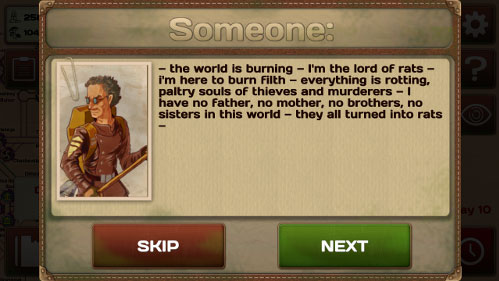
He has gone insane, but this boss is the least of your problems.
The map is where you control just about everything in the game. You start from Bunker O-13 which houses the Vault, a place where you can hire mercenaries (special units) and use the hospital to heal up your squads quickly if you have the ammo (pre-war munition currency.). Beyond the bunker, it’s micro managing everything. Settlements are both your line of defense as well as your bases of operations, building structures for recruiting fighters, placing in defensive terrain (such as turrets and sandbags), beginning in mushrooms (food) and ammo (currency).
When you have recruited enough fighters, which come in the Melee, Ranged, and Support archetypes, you can start building squads and position them accordingly. The Garrisons will defend the settlement and act as the first line of defense while the mobile squads move between stations to meet their objectives. Word of advice (since I’ve learned this the hard way.): don’t go crazy with buying structures and fighters. Maintaining buildings in the settlements and your soldiers will cost you food and ammo. While mushroom and salary costs are small, they will build up. Everything can easily go down the drain if your fighters starve and start to tear down structures to revolt.
During battles, your squad and the enemy units take turns until one side wipes out the other. The Order of Action Panel will tell you the order of initiation, which helps you tremendously. You can see whose turn it is (clicking the portrait on the panel will give a quick highlight to where the character is.) and quickly dispatch the tougher enemies before they get a turn. On a fighter’s turn you can either select a skill (several, including healing, buffing, attacking, etc.), move somewhere on the field, or have them wait it out. While moving they can take cover behind a box or a barrel which can give the inexperienced level 1 character a fighting chance.
If you need a more in-depth detail about your enemy or your fighters, you can tap hold on the unit and check the character sheets for stats, skills, weaknesses, and resistances. There are two best course of actions when battling. The first is to single out one target after the other. It’s better just to take out one at a time instead of spreading the damage across especially if you need to take out a dangerous enemy because of their skills or higher than usual HP. The second is similar to the first, but it’s more in regard to boss fights: kill the minions first before taking out the boss. The boss will take some time to kill, but the minions will wear down your troops before you can get his HP down to a quarter.

Plan your actions right and the enemy will fall sooner than you expect.
Before I get into the graphics in the game, I really need to bring up one detail first: the female character designs. While the men are (for the most part) covered with clothes and armor the ladies seem to have a lack of thereof. There’s nothing wrong with showing a bit of skin and curves. However, it downplays on the realism of this being a post-nuclear apocalyptic themed game. That being said, the rest of the art direction matches what the theme is supposed to be: dark, dirty, and worn from war. The Metro has seen better days as it looks worn from turf wars while littered with the usual abandoned boxes, radioactive barrels, and planks of wood. And the character designs are a mixed expression.
You have the ladies that are too sexy for the apocalypse (I don’t think Metro 2033 was suppose to be a B-Movie type of story.), men who are covered with what they could find to protect themselves with, and then you have odd fashion designs like the Russian Ronin (Hunter of the Order). The loading screens use some use some nice comic style artwork. These pictures actually tell the background story of Metro 2033 in a sense from the average day to surviving the tunnels.
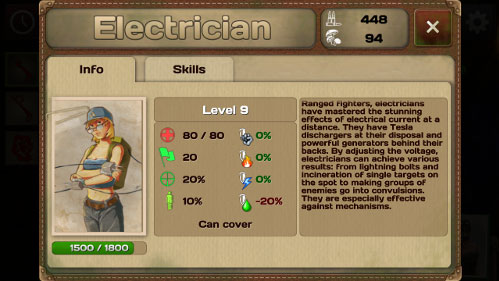
Her outfit doesn’t seem to protect her from bullets or her own electric prods.
There isn’t much I can say about the music. While it doesn’t get carried away or plays it down that there aren’t any tracks that come to mind. The voice acting, on the other hand, is good. Being developed by a Russian studio one would expect that the characters would sound Russian. However, I can’t tell if they’re hamming it up or not. Well, at least the music and acting setup set the right setting and mood from the very start.
Being a mobile game the controls are naturally touch screen based. The zoom controls uses the same finger gestures when increasing or decreasing and sliding your finger across the screen will move the map/field. Between the map and battle screens you can tap, drag, and drop fighters into their positions while using icons for everything else. Essentially straightforward controls but there is one thing that can be frustrating: moving your character to cover. Supposedly, you can move from one column to the other and take cover at the same time, but I only got that to work once by accident. The easiest method I could find is to move the character to the column with the covering point(s) and then tap that object on their next turn. It may take a few turns but by then you might be able to figure out the one turn method.
Pros:
+ A good game for those that like micro managing.
+ The post-apocalyptic Metro 2033 theme seems to be there.
Cons:
– Kind of hard to take seriously with the art design at times.
– The difficulty may be intimidating for those looking for a pickup and play title.

Verdict: 3/5
It’s a decent mobile game, but it comes with a bit of a difficulty curve. After some patience and diligence, the game does become easier. It may be worth the $6. However, you better be ready to take the micro management seriously before playing. If that’s your sort of thing, then you’re already on track with this game.
Title: Metro 2033 Wars: Born In The Dark
Developer: DaSuppa Studios
Format: Android, iOS, Windows
Genre: Strategy RPG
Resolution: Depends on device
Release date: 2015-11-18
Difficulty: Hard
Spent time: 4+ hours
Average grade internationally: 50.00% Gamerankings.com
PEGI/ESRB age rating: PEGI 16/Teen-Mature
Price: $5.99
***Disclosure***
The Metro 2033 Wars: Born in the Dark review code was provided by oneplay.com

David Lucas
The Gaming Ground
Twitter: @GamerFoxem
More by Guest Author:
Tags: Android, Born in the Dark, DaSuppa Studios, Metro 2033: Wars, Metro 2033: Wars Android review